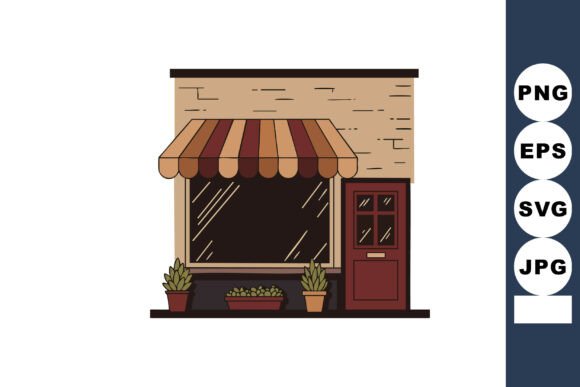
Small Storefront with Striped Awning Graphics
As a brand designer who’s helped over 80 local businesses refine their visual identity—from neighborhood bakeries to handmade candle studios—I opened Small Storefront with Striped Awning and expecting charm. What I found was more: a quietly confident graphic design asset that lands right at the intersection of warmth and professionalism. It’s not just clipart—it’s a mood-setter, a storytelling device, and a surprisingly flexible anchor for small business branding.
A Cozy First Impression That Builds Trust Instantly
The Vector graphic of a small store exterior with large window, door, striped awning, and decorative plants presenting a cozy scene. Calm mood. The downloadable ZIP includes SVG, EPS, JPG and PNG files. delivers exactly what its description promises—but its real power lies in how it feels. That striped awning? It reads as approachable, not kitschy. The large window suggests transparency—literally and metaphorically. The potted plants add organic softness without clutter. This isn’t “cute” or “trendy.” It’s reassuring: the kind of visual that makes customers pause mid-scroll on Instagram or linger longer beside a shelf display.
For a real-world project—say, rebranding a family-run herbal tea shop in Portland—I used Small Storefront with Striped Awning and as the central motif on product labels, thank-you cards, and seasonal packaging. It instantly communicated “handmade,” “local,” and “thoughtfully curated”—without needing a single word. That calm mood translates directly into customer trust, especially for food businesses, skincare brands, and boutique owners who rely on emotional resonance over loud claims.
Where This Illustration Earns Its Place in Real Branding Work
Small Storefront with Striped Awning and shines brightest where authenticity and warmth matter most:
- Product labels and packaging accents — Works beautifully as a foil to clean typography on glass jars, kraft paper bags, or soy-based soap boxes
- Hero graphics for websites and social media banners — Scales cleanly from Instagram Stories to full-width web headers thanks to its SVG and EPS formats
- Printable design elements — Perfect for hang tags, recipe cards, or seasonal campaign inserts (think “Holiday Pop-Up Shop” or “Spring Refill Week”)
- Product mockups — Adds instant context when showcasing new candle scents, small-batch preserves, or ceramic mugs on Etsy or Shopify
- Social media graphics and marketing visuals — Especially effective for “behind-the-scenes” posts, grand opening announcements, or “Meet Our Shop” carousels
In each case, it strengthens visual hierarchy—not by shouting, but by grounding busy layouts with familiar, human-scale architecture. That storefront becomes a quiet signature, reinforcing brand identity across touchpoints without repeating a logo.
Where to Use It Thoughtfully (Not Everywhere)
This illustration is versatile—but not universal. As a designer, I’ve seen it misapplied in ways that dilute impact or confuse messaging. Avoid using Small Storefront with Striped Awning and in:
- Formal corporate branding — Its warmth doesn’t align with law firms, financial advisors, or B2B tech services
- Very small labels or ingredient-heavy packaging — At under 1.5 cm tall, detail loss in the awning stripes or plant shapes weakens recognition
- Luxury minimalist brands — If your aesthetic leans into monochrome, negative space, and extreme restraint, this graphic adds visual weight you may not want
- Low-contrast backgrounds — The PNG’s transparency works well, but subtle gray tones in the awning can vanish on light beige or oat-colored packaging unless tested
- Legal or regulatory areas — Never place it near required text like net weight, allergen statements, or FDA disclaimers—it competes for attention
Practical Designer Notes You’ll Actually Use
Before locking in Small Storefront with Striped Awning and for client work or your own product line, run these checks:
- Test it on real packaging mockups — Print a 3x3 cm version on your actual label stock; see how the awning stripes hold up
- Check black-and-white usage — Convert to grayscale: does the awning still read as patterned, or does it flatten into a blob?
- Preview it beside your brand fonts — Try it next to serif (e.g., Playfair), sans serif (e.g., Inter), script (e.g., Pacifico), and handwritten styles—does it complement or clash?
- Confirm commercial licensing — Even if sourced from a creative marketplace, verify it permits use on physical goods, digital products, and client projects
- Inspect SVG editability — Open the vector file in Illustrator or Affinity Designer: can you recolor the awning independently? Adjust plant opacity? That flexibility matters for seasonal palette shifts
- Compare against competitor packaging — Does it help you stand out on shelf or blend in? For handmade business differentiation, uniqueness is non-negotiable
More Than Decoration—It’s Strategic Visual Consistency
What separates Small Storefront with Striped Awning and from generic illustration is how easily it integrates into a cohesive system. Used consistently across product labels, website banners, and social media graphics, it becomes part of your brand’s visual grammar—like a recurring character in a story. Customers begin to recognize that awning before they even see your logo. That’s stronger first impression. That’s better product recognition. That’s professional branding built on emotional consistency, not just aesthetics.
Whether you’re designing for a children’s toy shop launching a summer pop-up, a floral studio updating their thank-you cards, or a coffee roaster rolling out limited-edition bags, this graphic design asset supports your goals: clearer visual hierarchy, improved shelf appeal, more polished marketing visuals, and—critically—a warmer, more memorable connection with local customers.
Just remember: great illustrations don’t replace strategy—they amplify it. Use Small Storefront with Striped Awning and intentionally, test relentlessly, and let its calm mood do the quiet work of building trust, one local business at a time.