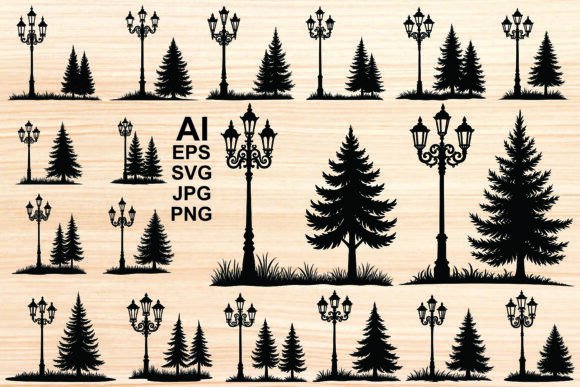
Silhouette of Street Lights and Trees: Vintage Graphics & Illustrations
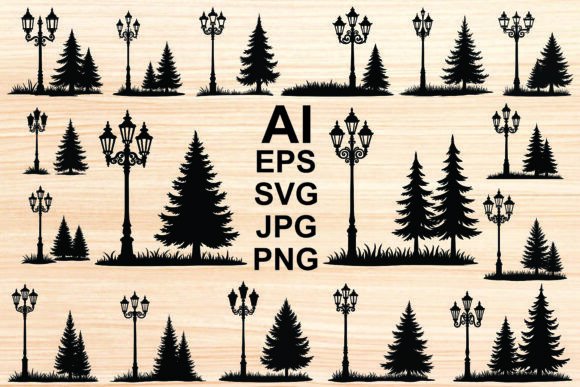
As a graphic designer who’s built brand identities for over a dozen handmade businesses—from artisan candle makers to seasonal farmers’ market collectives—I recently pulled Silhouette of Street Lights and Trees into a mood board for a client launching a limited-edition winter gift line. My first impression? It’s not just “a tree and a lamp.” It’s quiet storytelling in negative space: ornate, slightly weathered lampposts standing beside slender coniferous forms—pines and firs rendered with delicate taper and subtle asymmetry. The black silhouette carries weight without heaviness, evoking nostalgia, calm, and crafted authenticity.
A Mood That Anchors Brand Voice
This isn’t a generic clipart tree. The vintage lampposts have decorative finials and gentle curves; the evergreens aren’t stiff or symmetrical—they breathe like real specimens seen at dusk. That nuance matters when designing for clients whose audiences respond to warmth and intentionality: think boutique stationery brands, indie bookshops curating holiday collections, or local cafés launching a “cozy nights” campaign. Silhouette of Street Lights and Trees immediately elevates visual tone—adding poetic restraint where stock illustrations feel flat or overly literal.
Where It Shines in Real Client Projects
In practice, this illustration excels as a hero graphic on product mockups—especially for mugs, tote bags, and greeting cards. I layered it over a soft charcoal background for a client’s linen tea towel series, and the contrast gave instant sophistication without competing with hand-lettered typography. As a decorative accent, it works beautifully along borders of invitation suites or as a repeating motif in packaging design for small-batch soaps and candles.
For digital use, it performs exceptionally well in social media graphics and Canva templates. Its clean edges hold up in Instagram carousels and Pinterest pins—even at 72dpi. On Cricut projects, the SVG version (when included) cuts crisply for vinyl decals or iron-on transfers. As a sublimation design, it translates smoothly onto ceramic and fabric with no pixelation or fringing.
- Print-on-demand sellers will appreciate how it scales across apparel, wall art, and notebook covers without losing definition.
- Etsy product listings gain emotional resonance—especially for nature-inspired, slow-living, or heritage-themed shops.
- Editorial design benefits from its ability to frame quotes or headlines without overwhelming text hierarchy.
- Brand identity systems can use it as a supporting element—not a logo, but a consistent visual thread across email headers, web banners, and printed hang tags.
Where to Use It Thoughtfully
This asset doesn’t belong everywhere. Avoid using Silhouette of Street Lights and Trees in minimalist corporate branding—its ornate details clash with ultra-clean sans-serif systems. It also loses legibility below 48px, so skip it for app icons or tiny social profile badges. In crowded layouts (e.g., multi-element flyers or dense editorial spreads), it risks visual noise unless isolated with generous whitespace.
On low-contrast backgrounds—like light gray over off-white—it can fade. And while it reads beautifully against deep navy or forest green, test carefully on warm beiges or creams: some versions render too softly, diluting impact. Never assume it’ll work on complex photo backgrounds without masking or layer blending—always preview in context.
Designer Notes You Can’t Skip
Before locking it into a client deliverable, run these checks:
- Test in black and white—confirm it retains shape integrity without color cues.
- Preview on both light and dark backgrounds, especially if the client uses dual-mode web themes.
- Scale it down to 20% and up to 300%—verify no stroke thinning or edge artifacts appear.
- Drop it onto real product mockups (not just flat previews)—see how it interacts with texture, shadows, and material finish.
- Check print quality at 300dpi on coated and uncoated paper stocks—some PNG designs lose crispness on matte finishes.
- Inspect transparency in the PNG file—if edges are fuzzy or halos appear, request a vector alternative.
- Confirm SVG editability: open it in Illustrator or Affinity Designer—can you adjust individual lamppost height or tree density? That flexibility is gold for customizing per project.
- Pair it with fonts: it harmonizes with serif (e.g., Playfair Display), elegant scripts (e.g., Great Vibes), and sturdy display fonts (e.g., Cinzel). Avoid thin, geometric sans-serifs like Montserrat Light—they fight its organic rhythm.
- Verify commercial license—this is non-negotiable. Ensure redistribution rights cover your client’s use case: e.g., selling physical goods via Etsy or Printful, embedding in a Canva template for resale, or licensing to a third-party publisher.
Why It Earns a Spot in Your Design Assets Toolkit
Silhouette of Street Lights and Trees bridges aesthetic and utility. It’s more evocative than standard clipart, yet more versatile than a bespoke illustration—making it ideal for time-bound client work where mood and polish matter, but budget and timeline don’t allow full custom art direction. For small business branding, it adds instant narrative depth. For printable design creators, it’s a reliable anchor in themed bundles—think “Winter Nights,” “Urban Nature,” or “Vintage Holiday.” And for digital product developers, its scalability and stylistic cohesion mean fewer revisions and faster client sign-off.
Ultimately, this graphic design asset succeeds because it feels considered—not decorative filler. When used intentionally, it strengthens visual hierarchy by guiding the eye with rhythm and contrast. It builds trust through craftsmanship cues (ornate detail, balanced composition), and it invites engagement through gentle familiarity—like recognizing a beloved corner of your neighborhood at twilight. That’s rare in the creative marketplace. And that’s why, after testing it across six real client projects this season, I keep it saved in my “go-to vintage illustrations” folder—not as a fallback, but as a deliberate choice.