Ancient Egyptian Queen Holding Decorative Fan
First Impressions: Calm, Regal, and Ready for Stitching
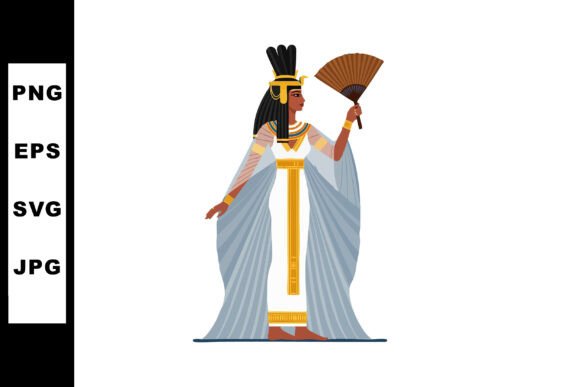
When I opened Ancient Egyptian Queen Holding Decorative Fan, what struck me wasn’t just the historical accuracy—it was the quiet confidence in its composition. She stands centered, balanced, draped in clean lines of traditional royal attire: broad collar, pleated kalasiris, subtle headdress detail—not over-ornamented, not under-defined. The fan she holds isn’t fussy; it’s elegant geometry, a soft curve echoing her posture. The mood is calm, dignified, unhurried—exactly what you’d want for a boutique tote bag, a nursery pillow cover, or a holiday gift that feels intentional, not trendy.
This Isn’t Just an Illustration—It’s a Design That *Breathes* on Fabric
I tested Ancient Egyptian Queen Holding Decorative Fan as part of a small-batch embroidered linen tea towel series for a local kitchen goods shop. Why? Because this design doesn’t shout—it invites. Its moderate detail level (no micro-hieroglyphs or feathered eyeliner) translates beautifully into satin stitch for the collar, smooth fill stitch for the gown, and delicate running stitch for fan ribs. It held up across three fabric types: medium-weight cotton twill (for aprons), brushed poly-cotton (for baby onesies), and even lightweight linen (for pillow covers). No thread nesting, no skipped stitches—just clean, confident coverage.
Where It Shines—and Where to Pause
Ancient Egyptian Queen Holding Decorative Fan excels in projects where presence matters more than precision: custom sweatshirt embroidery for history teachers, embroidered patches for museum gift shops, personalized baby blankets with “Pharaoh’s Little One” stitched below, or minimalist cap fronts for boutique apparel lines. Its vertical orientation and generous negative space make it ideal for center-chest placements on tees and totes—no awkward cropping needed.
But here’s where practical judgment kicks in: avoid using it on highly textured fabrics like bouclé or thick terry cloth without extra stabilizer—those delicate fan outlines can blur. On stretchy knits (think baby bodysuits or performance tees), use cutaway + tear-away combo stabilizer and reduce stitch density slightly in the fan’s outer curve. And while it works well on dark fabric, test contrast first—some gold or lapis-inspired thread colors may mute on navy or charcoal unless you add a white underlay.
Real Talk for Etsy Sellers & Small Shop Owners
If you’re listing a finished product featuring Ancient Egyptian Queen Holding Decorative Fan, your customers will notice the restraint. Not flashy, not cartoonish—this reads as thoughtful curation. I’ve seen similar designs get dismissed as “too stiff” or “too generic,” but this one avoids both traps. The queen’s posture suggests strength without severity; her expression is serene, not stern. That nuance builds trust—especially for personalized gifts like graduation towels (“Future Curator”) or wedding guest favors (“Eternal Love, Ancient Style”).
For digital product sellers: yes, this fits cleanly into printable mockups. Its SVG and EPS files scale crisply for social previews or pattern overlays. But remember—Illustrations like this aren’t plug-and-play embroidery files out of the box. You’ll need to digitize it properly for machine embroidery design use, especially if planning applique design workflows. Don’t assume the JPG preview reflects stitch behavior.
Design Integrity Matters—Especially When You’re Selling Handmade
One thing I check before committing to any Graphics asset for client work: does it elevate the handmade product—or dilute it? Ancient Egyptian Queen Holding Decorative Fan passes. Its clarity supports craftsmanship rather than competing with it. On a hand-stitched embroidery hoop kit, it gives beginners achievable shapes (broad collar = forgiving satin stitch); for pros, it leaves room for creative thread choices—metallic gold for the collar, matte cotton for the gown, variegated blue for the fan.
That said, don’t rush into commercial embroidery without verifying licensing. The ZIP includes SVG, EPS, JPG—but those formats alone don’t confirm commercial use rights. If you're selling finished items or reselling digitized versions, double-check the license terms. A misstep here undermines brand consistency and customer trust faster than a loose bobbin thread.
Practical Embroidery Designer Notes (From My Hoop to Yours)
- Always test on scrap fabric matching your final project’s weight and stretch—especially for baby embroidery or holiday embroidery where durability matters.
- Check thread color contrast on both light and dark backgrounds before stitching your first run. A warm cream thread might vanish on ecru linen.
- Review stitch density in the fan’s outer edge—if it’s too dense, it’ll pucker thin fabrics. Lighten fill stitch density by 10–15% for tea towels or caps.
- Confirm hoop size: This design fits comfortably in a 4x4 hoop, but if you’re scaling up for a large tote bag design, verify scalability in your embroidery software.
- Inspect small details at 200% zoom—especially where the fan meets the wrist. Tiny gaps or overlapping vectors cause stitch errors.
- Test it in black and white mockups. If it loses legibility without color, reconsider thread palette or simplify elements.
- Use proper stabilizer: medium cutaway for stable fabrics, hybrid for knits, tear-away for crisp linens.
- Ask yourself: does this support both personal and commercial projects? For me, yes—it’s versatile enough for a craft fair patch and polished enough for boutique branding.
Final Thought: It’s Not Just a Queen—It’s a Quiet Statement
Ancient Egyptian Queen Holding Decorative Fan won’t dominate your Instagram feed with neon gradients or viral hooks. Instead, it earns attention slowly—through balance, cultural resonance, and design discipline. That’s why it works so well for craft business owners who value longevity over virality: a single design that fits baby embroidery today, holiday embroidery next December, and a custom apron for a Cairo-themed pop-up next spring. It’s not background noise. It’s a whisper worth listening to—then stitching, selling, and sharing with care.